


As the academic year winds down, we tend to see the same patterns: minor maintenance problems becoming bigger ones, contracts getting signed without a close read, and informal practices—like porch pickups—creating unexpected risk. We’re also seeing an uptick in claims tied to unofficial housing, making this a good time to revisit expectations and daily habits that can quietly create exposure over time.
In this month’s News & Notes, we’re sharing practical reminders to help you stay ahead of those issues, from drain and sewer care that can help prevent costly backups to leak detection, smart home tools, a straightforward summer closing checklist, and contract basics.
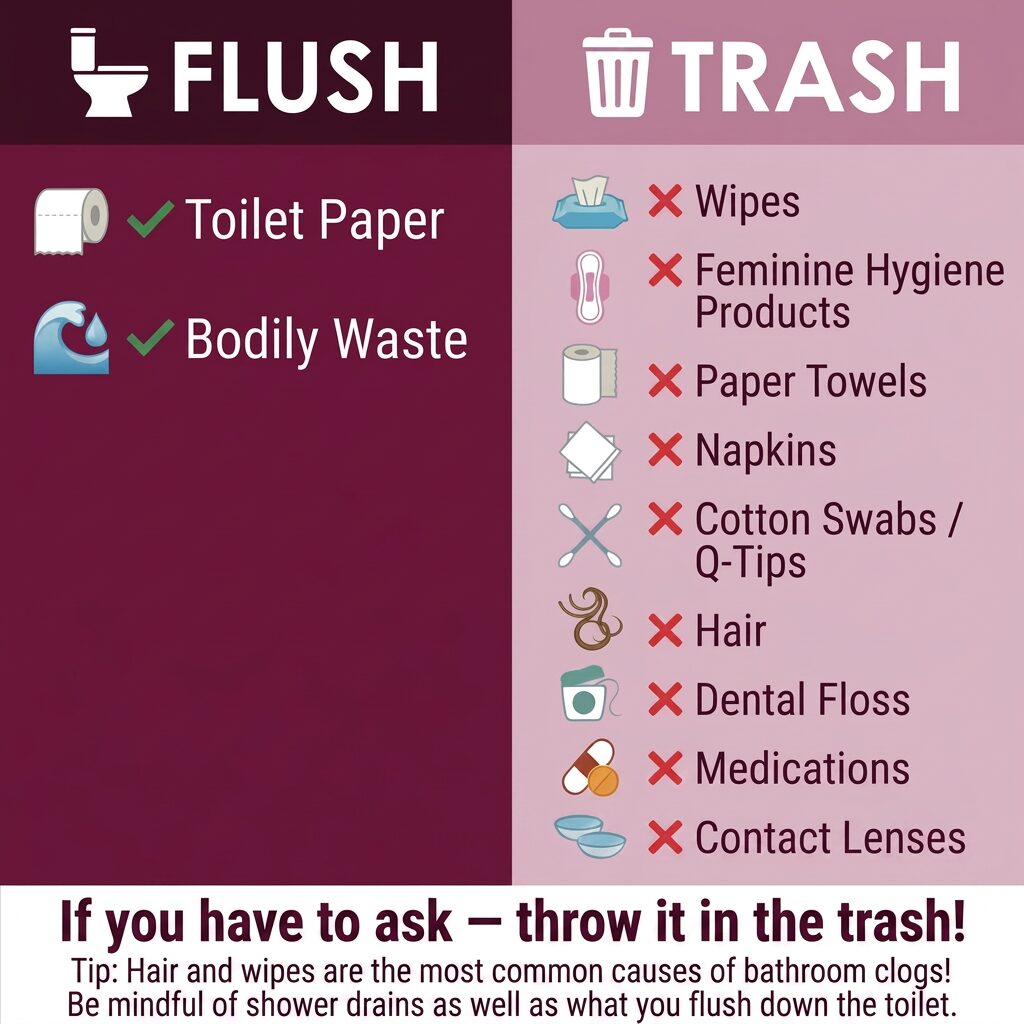
Improper use of sinks, toilets, and disposals can lead to backups and damage. This article outlines best practices to help protect our house, but we also created the following signs for house corporations to post around the chapter house.
Right click on the graphic to save your graphic and print copies for your chapter house.
Sorority housing is a shared environment and the way members and staff use the property directly impacts the safety, functionality, and long-term resiliency of the chapter house.
One of the most common and most preventable sources of property damages in chapter house facilities is improper use of plumbing systems. What goes down the drain does not magically disappear! Over time, certain materials accumulate within pipes, increasing the likelihood of blockages, backups, and costly repair.
We have partnered with Fluid Waste Services to compile a list of the most frequent offenders of sewage blockage and backups and the best practices to combat pipe and resulting property damage. This guidance is intended to support responsible use of plumbing systems and to outline best daily practices, as well as proactive maintenance strategies to protect your chapter house.
Toilets: What to Flush
Toilets are designed to handle human waste and toilet paper. That’s it! Pretty simple, right? Wrong. Chapter members often flush feminine hygiene products, wipes (including those labeled “flushable”), hair, floss, cotton swabs, and more. Posting clear and visible signage in your bathroom facilities outlining what’s “flushable” can help combat this problem. Our team has created a flyer included in this article for your use.
It’s also prudent to keep in mind that vomit is highly acidic and can, over time, contribute to pipe deterioration. When possible, it’s always best to use a trash can when fighting a stomach bug.
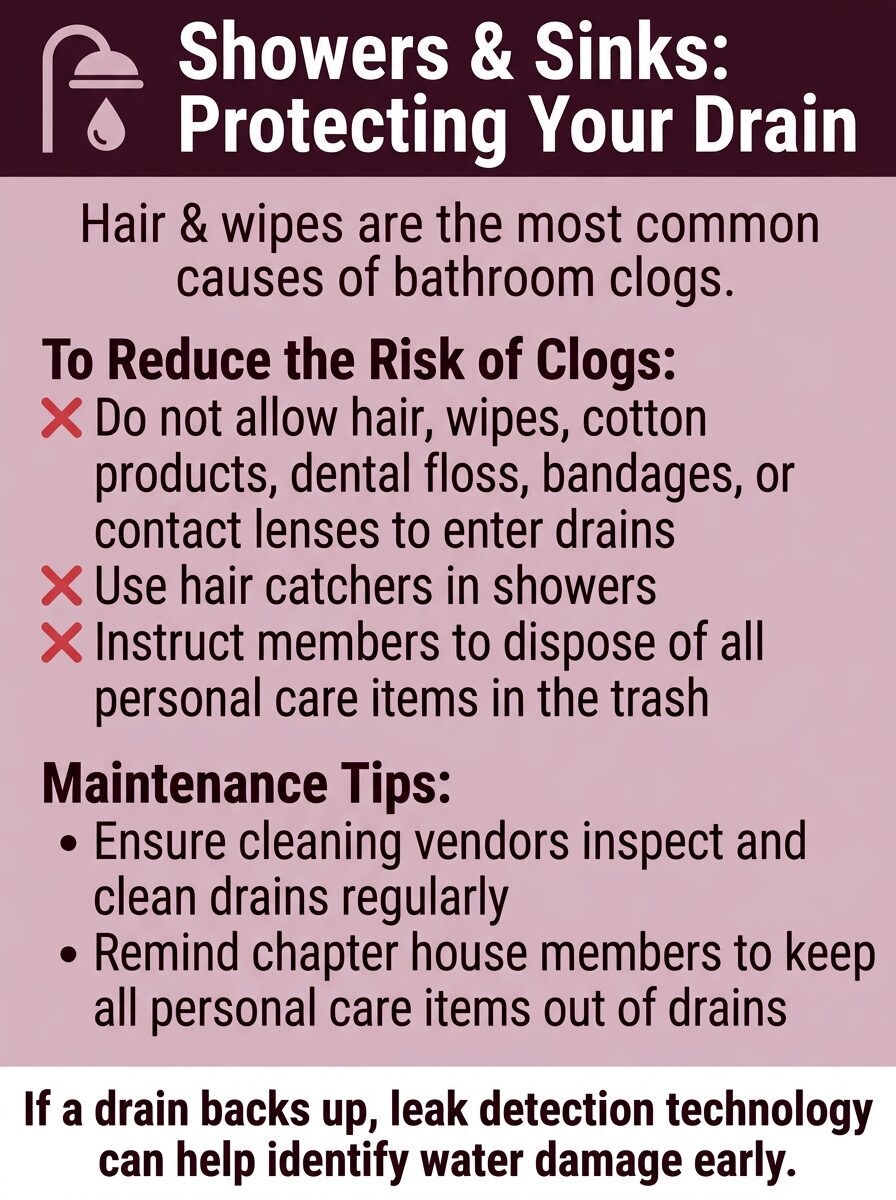
Showers & Sinks: Protecting Your Drain
Hair, along with wipes, are the most common causes of bathroom clogs. To reduce the risk of clogs:
- Do not allow hair, wipes, cotton products, dental floss, bandages, or contact lenses to enter drains;
- Use hair catchers in showers; and
- Instruct members to dispose of all personal care items in the trash.
Be sure that your cleaning vendor or other responsible staff member is well versed in this risk management technique. Drains should be inspected and cleaned regularly and women living in the chapter house reminded to refrain from putting any of the materials listed above down any drain.
If a pipe or drain becomes clogged and begins to backup, leak detection technology can be helpful in identifying water before it becomes a larger problem. Click here to learn more about these systems and their advantages.
Kitchen Sinks: Grease and Food Waste
Bathrooms aren’t the only common place where pipes get backed up. Kitchen drains are also particularly vulnerable to buildup and blockage.
Grease, including oil, butter, fats, and sauces, is one of the leading causes of sewer issues in shared housing. When poured down the drain, grease cools and solidifies within pipes, restricting flow and increasing the likelihood of backups.
The following should never go down the kitchen drain:
- Grease, oil, butter, or fats;
- Food scraps (including rice, pasta, and coffee grounds);
- Egg shells; or
- Flour or dough
This applies even when a garbage disposal is present.
Best practice is always to allow grease to cool, transfer it to a container, and dispose of it in the trash. Chefs, kitchen staff, and members should scrape all plates and cookware into the trash before washing. Kitchen staff handling grease should be sure that it’s handled with care and completely cooled before throwing in the trash as it can become a fire hazard.
Proper food disposal can also be encouraged by strategically placed signage in dining and kitchen areas. This is especially important for open kitchens, where women are presumably using the kitchen without supervision.
Proactive Maintenance
In addition to the daily best practices outlined above, proactive maintenance of your entire plumbing system is essential. High frequency of use places significant strain on pipes, making routine inspection and cleaning a key component of preventing plumbing failure.
At a minimum, the following maintenance standards should be observed:
- Annual professional inspection: Camera inspection of the main sewer line to identify early-stage blockages, regular pipe deterioration, or root intrusion.
- Preventative cleaning: Performed 1-2 times annually (depending on usage and claims history), with emphasis on kitchen lines and bathroom drains to unclog potential blockages
- Trigger-based inspections: Evaluations should be performed immediately if any warning signs appear including slow drains, recurring clogs, odors, or gurgling pipes
These best practices allow for issues to be uncovered before they become larger problems and extend the life of your plumbing infrastructure.
Why This Matters
These may seem like small suggestions, but they make a big difference in the health and maintenance of your pipes. While damage can sometimes be immediately apparent, often less obvious ware and tear of pipes is accelerated and the consequences heightened by everyday practices by those that use the plumbing.
Improper drain use is not a minor inconvenience and the consequences of improper use and maintenance can interrupt member experience, cause secondary perils like mold or other biohazards, and lead to even larger problems down the road. From a financial standpoint, these events can be significant. Clearing a single blockage may cost several thousand dollars, while pipe repairs or replacement can escalate to five to ten times that amount.
If you have any concern about the health of your pipes or want to better understand the types of materials and other conditions of your plumbing systems, it’s recommended to contact a plumbing company who can scope your plumbing infrastructure and offer as assessment of its health.
Conclusion
Maintaining the health of your plumbing infrastructure ultimately comes down to consistency in daily practices and preventative maintenance. Post clear signage (we created some signage for your use), ensure that annual maintenance visits are planned and executed, and educate your members, staff, and vendors on signs of blockage or other pipe damage.
When these principles are embedded into operations and culture, your property is better positioned to operate smoothly with fewer unexpected disruptions over time.
As we move into spring, we also enter the start of severe weather season, a time when we typically see an uptick in both property and liability claims. Hail and wind events can quickly expose vulnerabilities in chapter facilities, while increased activity in and around the house can introduce additional liability considerations that may not always be top of mind.
In this month’s News & Notes, we’re taking a closer look at two areas where we continue to see losses occur: severe convective storms impacting chapter properties, and premises liability exposures related to how chapter houses are used, particularly when it comes to rentals, third-party access, and informal arrangements like porch pickups.
While these risks are different, the takeaway is the same: preparation matters. The steps taken before an incident, whether that is a storm or a liability claim, often have a direct impact on how smoothly recovery and resolution unfold.
From a practical standpoint, that includes:
- Completing regular property inspections and addressing maintenance concerns early
- Documenting the condition of the property, especially ahead of storm season
- Understanding where liability may exist when the property is used by others
- Communicating with members to ensure they know what to do and who to contact when something happens
At MJ Sorority, we focus on helping sorority chapters and house corporations stay prepared, not just protected. We work with top-tier insurance carriers who understand the complexities of sorority housing and the sorority experience, and we advocate for our clients throughout the process, from coverage development to claim resolution.
As you read this month’s articles, we encourage you to consider where a few intentional steps now can help reduce uncertainty later, both in preventing losses and in navigating them if they occur.
Peer-to-peer clothing rental and resale platforms are becoming common on college campuses. Whether facilitated through an app, social media, or arranged informally between students, porch pickups may feel harmless and convenient.
From a risk management standpoint, they are not.
When you invite non-members onto sorority property, even briefly, you elevate your liability exposure. And under premises liability law, individuals you invite onto your property are often owed a higher duty of care.
A Claim Example
Recently, this risk has been tested at a chapter house porch pickup.
A non-member purchased a dress from a sorority member and was instructed to pick it up from the chapter house porch. It was winter and the chapter house failed to maintain the rear access ramp in a reasonably safe condition during known icy weather. Property managers knew of the hazardous condition (significant ice accumulation and multiple falls reported the same day) and did not adequately remediate, treat, or warn of the danger. While approaching the porch, the non-member slipped, fell, and fractured her elbow and required surgery.
Because this non-member was invited onto the property for a transaction, she is owed a higher duty of car. What followed was a premises liability claim alleging failure to maintain safe conditions. What felt like a casual exchange became an insurance event.
Understanding Your Duty of Care
In most jurisdictions, visitors are classified into legal categories that determine the duty owed to them. The chart below outlines the duties owed to different types of visitors to a property.
| Invitees (Business/Public Visitors) | Licensees (Social Guests) | Trespassers |
| Highest Duty Owed | Duty Owed | Lowest Duty Owed |
| An invitee is someone invited onto property for a purpose that benefits the organization or its members. A clothing rental or resale pickup may fall into this category. | Even under this classification, failing to address known hazards can result in liability. | Trespassers are owed the lowest duty. Individuals picking up clothing items at a member’s invitation are not trespassers, they are invited guests. |
For invitees, you are typically required to:
- Actively inspect the premises;
- Repair hazardous conditions;
- Warn of non-obvious dangers; and
- Maintain reasonably safe walkways and entrances.
This is the highest duty of care under premises liability standards. If a known hazard exists, like uneven concrete or icy conditions, and no corrective action is taken, liability exposure increases significantly.
Why Porch Pickups Create Elevated Risk
Allowing non-members onto chapter property for transactions introduces several possible exposures:
- Slip, trip, and fall claims;
- Inadequate lighting hazards;
- Snow and ice maintenance failures;
- Security concerns involving unknown individuals; and
- Increased claims frequency.
Even if a member arranges the transaction personally, an injury occurring on sorority property can implicate the chapter and its insurance program.
Policy Consideration for Housing Corporations
Housing corporations should consider adopting a written policy addressing clothing rental, resale, and other peer-to-peer transactions that may bring non-members onto chapter house property. While chapters may choose to prohibit these exchanges on-site and encourage members to conduct them in public campus locations, it may not always be realistic to ensure that all transactions occur off property. For that reason, many housing corporations may find that mitigation is the next best option.
If transactions are permitted, consider establishing clear guidelines to reduce risk. Establishing clear expectations helps reduce ambiguity and demonstrates proactive risk management.
Best Practices
The safest approach is not to conduct clothing rental or resale pickups on sorority property. Encourage members to:
- Meet in public campus spaces;
- Use student union facilities; or
- Utilize neutral third-party pickup lockers or host locations like a resale storefront.
Removing the transaction from the property removes the premises liability exposure.
If your chapter chooses to allow pickups on property, risk controls are essential:
- Use a secure, weather-protected lockbox;
- Designate a single, well-lit pickup location;
- Maintain and routinely inspect access paths;
- Promptly remove snow and treat ice;
- Restrict visitors from entering residential areas;
- Place signage around and block off any hazards until they can be addressed; and
- Document maintenance efforts.
When you invite individuals onto your premises, you assume a heightened duty to ensure those premises are reasonably safe.
The Bottom Line
Slips and falls are among the most frequent and predictable liability claims across chapter house properties.
When you invite non-members onto sorority property, you elevate your legal duty of care. Invitees are typically owed the highest standard to maintain reasonably safe premises. To fulfill this duty you must actively inspect the premises, repair hazardous conditions, and warn of non-obvious dangers.
The most effective risk management strategy is to manage rental and resale transactions are to move these transactions off property. If that is not possible, ensure your chapter’s practices reflect the elevated duty you owe invited guests.
Prevention is always less costly than a claim and instilling best practices will protect your chapter from potential liability!
Winter can be especially hard on chapter facility roofs — even when there are no obvious signs of trouble. Snow load, ice dams, freeze-thaw cycles, high winds, and fluctuating temperatures all stress roofing systems in ways that may not be visible at the time. In many cases, damage that begins in January does not reveal itself until March or April — when melting snow and spring rains find pathways into the building.
As we move toward warmer weather, now is the right time to revisit the fundamentals of roof management and inspection.
Why Winter Damage Often Appears in Spring
Several common winter conditions contribute to delayed roof issues:
Freeze–Thaw Cycles
Water can enter small cracks or seams in roofing materials. When temperatures drop, that moisture freezes and expands, widening gaps and weakening seals. Repeated cycles can compromise flashing, membranes, and shingles.
Ice Dams
Ice dams form when snow melts and refreezes at roof edges. Water trapped behind the ice can back up under shingles and flashing, leading to interior leaks that may not appear until temperatures rise.
Snow Load & Structural Stress
Heavy snow adds weight to the roof system. Even if structural damage is not visible, prolonged load can strain decking and fasteners.
Wind Damage
Winter storms can loosen flashing, lift shingles, or damage roof penetrations. The impact may not be apparent until water intrusion begins.
Warning Signs to Watch For This Spring
As snow melts and spring rains begin, house corporations and facility volunteers should be alert for:
- Water stains on ceilings or walls – even minor staining can indicate a larger issue developing above
- Peeling paint or bubbling drywall
- Musty odors in upper floors or attic spaces
- Dripping near chimneys, vents, or skylights
- Shingles or roofing materials visible on the ground
- Damaged or detached flashing
- Flashing is thin metal installed at roof joints and transitions — most commonly around chimneys, vents, skylights, roof-to-wall intersections, and valleys — to direct water away from seams and prevent leaks.
Proactive Roof Management: Best Practices
Effective roof stewardship is not reactive — it is scheduled and documented.
1. Schedule a Professional Inspection
Early spring is an ideal time for a qualified roofing contractor to inspect the system, especially after a harsh winter. A documented inspection helps identify small issues before they become significant claims.
2. Maintain Clear Drainage
Ensure gutters and downspouts are clear of debris. Poor drainage accelerates roof deterioration and increases the risk of ice dam formation.
3. Document Repairs and Maintenance
Keep organized records of inspections, repairs, and warranties. Documentation supports long-term capital planning and can be important if a claim arises.
4. Plan for Replacement — Don’t Delay It
Roofs have a finite lifespan. If your system is nearing the end of its useful life, proactive replacement is typically far less disruptive and less costly than emergency repairs following a failure.
5. Address Small Leaks Immediately
Water intrusion rarely improves on its own. Prompt attention limits interior damage, mold development, and secondary costs.
Insurance Considerations
While insurance policies may respond to sudden and accidental damage, they are not intended to cover wear, tear, or deferred maintenance.
A well-maintained roof not only protects members and property — it also supports favorable insurance outcomes and reduces the likelihood of large, avoidable claims.
A Seasonal Reminder
Spring is a natural checkpoint for facility review. As part of your broader risk management efforts, add roof inspection and maintenance to your seasonal planning calendar.
If you have questions about roof management, capital planning, or property risk mitigation, MJ Sorority is here to help.
As winter winds down, now is the perfect time to check in on chapter operations and prepare for the busy spring season. From ensuring your facilities are weather-ready to planning safe, compliant events, a little proactive planning goes a long way.
In this issue, we cover roof care after winter, why reporting all property damage matters, and tips for planning safe, compliant spring events to keep members and chapter homes protected. Read the whole thing.
A resilient year doesn’t start with a claim or a crisis. It starts with clear expectations, smart planning, and a strong understanding of who is in your corner. As we head into the new year, we’re encouraging chapters and housing organizations to think about risk management as part of their day-to-day operations—not something that only comes into focus when there’s a problem.
MJ Sorority’s role is to be your advocate and advisor, not just the group that places your insurance. While insurance carriers make the final underwriting decisions, our job is to help you understand those requirements, prepare for them, and make informed choices that support your organization over the long term. We work alongside you throughout the year to reduce surprises and strengthen your overall risk position.
This January issue of News and Notes focuses on building that foundation—so you can move into the year ahead with confidence, clarity, and support. Read the whole thing.
As we wrap up another year, we’re taking a moment to celebrate all that your organizations, chapters, volunteers, and members have accomplished in 2025. In this month’s edition, you’ll find a year-in-review recap and a few timely tips to close out 2025 safely and confidently. Thank you for your leadership, dedication, and partnership.
As chapters prepare for Thanksgiving break and colder weather sets in, this month’s updates focus on simple steps to reduce risk and keep facilities safe. We’re sharing guidance on unofficial or privately rented houses, our Thanksgiving Break Checklist, a new webinar with Luminaut, some event planning resources and reminders, and practical slip-and-fall prevention tips for the season.
With the semester underway, September is a great time to hit pause, reset, and make sure your chapter is starting strong. In honor of Campus Safety Awareness Month, this issue highlights practical steps you can take to keep members safe, protect your property, and strengthen your chapter operations.
As your members return and the academic year begins, we’ve gathered timely updates to help your chapter and housing operations run smoothly. This month’s highlights include:
- How to safely reopen your chapter house after summer (or any) break
- Why it’s critical to report all wind and hail claims—even minor ones
- Key back-to-school reminder about university certificates of insurance
- Floodplain awareness and your property’s FEMA designation
- A real-world phishing scam close call you’ll want to share
- A fresh nudge to explore Events Central for your fall planning